
TRW & Co · Trade, Regulation & ESG
Customs and Trade Compliance in Singapore
Customs compliance in Singapore is about far more than duty. Every import, export and transhipment needs a permit, import GST applies to almost all goods, and schemes that suspend GST come with strict conditions. This guide explains the Customs Act and RIEA framework, classification, valuation and origin, audits and voluntary disclosure, and how to build a programme that stands up to scrutiny.
Key pointBecause Singapore levies duty on only four categories of goods, the real exposure sits in import GST, suspension schemes and origin claims; the importer of record, not its declaring agent, answers for every declaration.
At a glance
Permit for every movement
Imports, exports and transhipments need a TradeNet permit under the Customs Act and RIEA, usually lodged by a declaring agent acting in the trader's name.
Only four dutiable categories
Customs or excise duty applies to liquor, tobacco, motor vehicles and petroleum products; most other imports bear only import GST, currently 9%.
CIF-based customs value
Transaction value is primary, with freight, insurance, certain royalties and assists added; if conditions fail, importers must follow the WTO valuation hierarchy in order.
Five-year record retention
Singapore Customs expects supporting documents for permits to be kept for five years and produced on request, including records held by agents.
Schemes raise the stakes
Licensed Warehouse, Zero-GST Warehouse and Major Exporter Scheme status suspend tax but make stock accuracy and condition compliance a legal obligation.
Swipe or scroll →
What customs compliance in Singapore covers
Customs compliance in Singapore is the discipline of making every import, export and transhipment declaration true, complete and supportable. Singapore is a free port and charges duty on very few goods, so many businesses assume there is little to get wrong. That assumption is expensive. Import GST is charged on almost everything that enters, controlled goods need approvals before a permit issues, and each declaration is a legal statement made in the importer's or exporter's name.
The obligations reach well beyond the logistics team. Procurement sets the price and the Incoterm that drive customs value. Engineering knows the specification that decides tariff classification. Finance books the royalties and year-end adjustments that may need to be added to value. Sales makes the origin promises that support a buyer's preferential duty claim abroad. When those teams work from different data, declarations drift away from reality.
The question usually becomes a legal one at a predictable moment: a query or audit letter from Singapore Customs, a bank or buyer asking for proof of origin, a due diligence request in an acquisition, or an internal discovery that a declaring agent has been using the wrong code for years. The best time to deal with it is before any of those events.
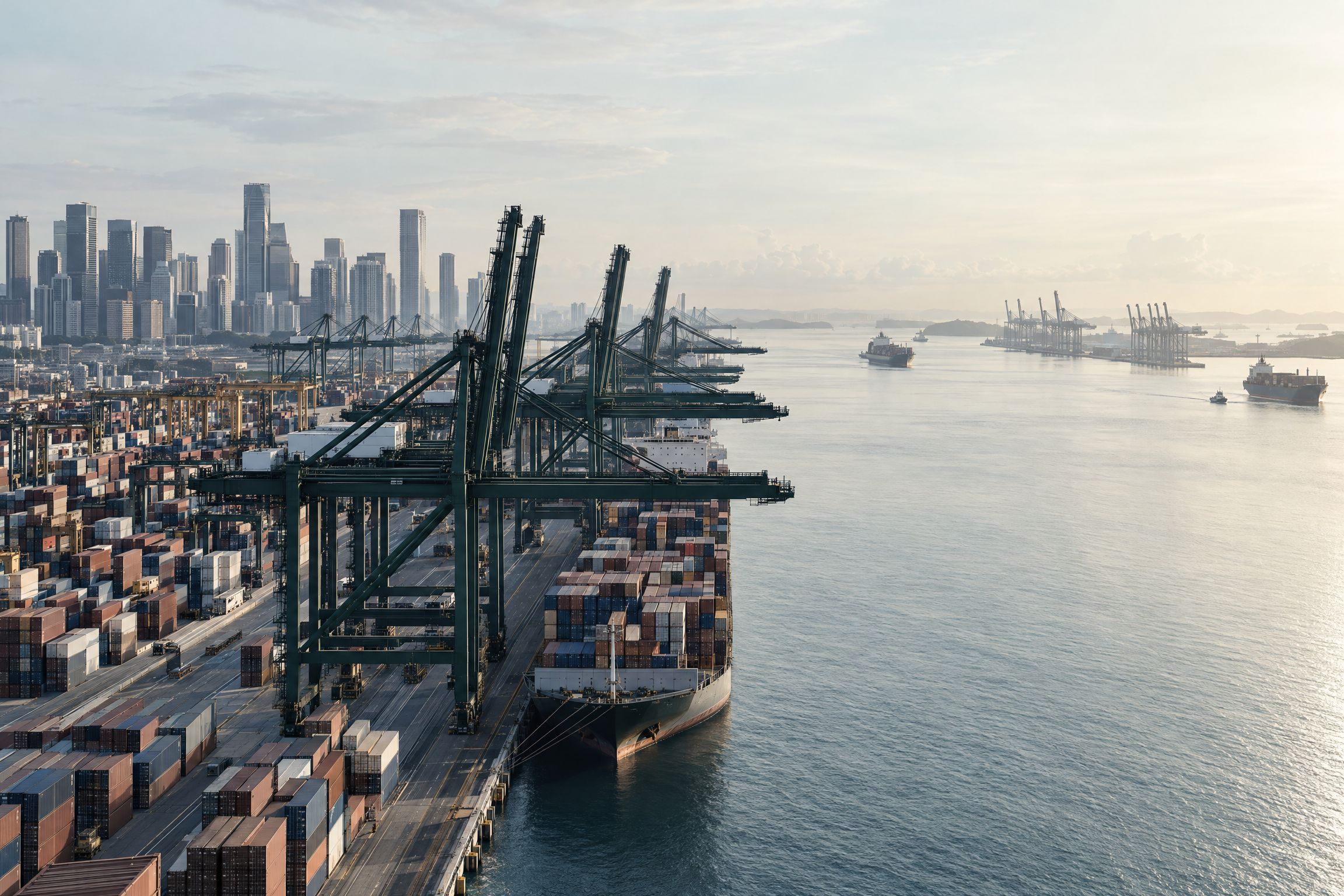
The legal and regulatory framework
Three statutes carry most of the load. The Customs Act 1960 governs the control of goods entering and leaving Singapore, customs duties and excise duties, customs valuation, licensed warehouses and the powers of officers to inspect, audit and investigate. The Regulation of Imports and Exports Act 1995 (RIEA) and its regulations require permits for imports, exports and transhipments and give effect to prohibitions and controls. The Goods and Services Tax Act 1993 imposes GST on imported goods, which Singapore Customs collects at the border on IRAS's behalf.
Around these sit the Free Trade Zones Act, which governs goods held in the port and airport free trade zones, and the Strategic Goods (Control) Act 2002 for dual-use and military items. Our page on import and export controls covers that strategic goods regime in detail.
Singapore Customs and the competent authorities
Singapore Customs, a department of the Ministry of Finance, administers the permit system, valuation, classification, origin and the trade facilitation schemes. Permits are lodged electronically through TradeNet, the national single window, usually by a declaring agent. For controlled goods, a separate competent authority must approve before the permit issues: for example the Singapore Food Agency for food, the Health Sciences Authority for medicines and medical devices, the National Environment Agency for certain chemicals and pesticides, and IMDA for some telecommunications equipment.
Singapore Customs' import procedures overview confirms the baseline: imported goods are regulated under the Customs Act and the RIEA, a permit is required to account for the import and the payment of taxes, and supporting documents must be kept for five years.
| Data point | What it determines | Where the rules sit | Most common error |
|---|---|---|---|
| Tariff classification (HS code) | Duty status, control status, permit type, statistics | Singapore's tariff nomenclature, based on the ASEAN Harmonised Tariff Nomenclature | Copying a supplier's or another country's code without checking Singapore's tariff and the product's real function |
| Customs value | Import GST and any ad valorem duty | Customs Act and Singapore Customs' valuation guidance | Declaring the FOB invoice without adding freight, insurance, royalties or assists |
| Origin | Preferential duty at destination; certificates of origin | FTA rules of origin and Singapore Customs' rules of origin guidance | Claiming origin after minimal processing in Singapore |
| Control status | Whether a competent authority must approve first | RIEA regulations, SGCA and agency-specific laws | Treating controlled goods as general cargo because the HS code looked harmless |
Duty, import GST and the schemes that change cash flow
Only four categories attract customs or excise duty: intoxicating liquors, tobacco products, motor vehicles, and petroleum products and biodiesel blends, as Singapore Customs explains on its dutiable goods page. For everything else, the money at stake is import GST, charged at 9% on the customs value plus any duty and other charges. For a GST-registered business that can reclaim input tax, the cost is mainly cash flow; for an exempt or partially exempt business, such as many financial institutions, it is a real cost.
That is why the schemes matter. Used well, they suspend or remove GST at the border and shorten clearance. Used carelessly, they create the largest exposures, because the duty or GST that was suspended becomes payable if conditions are breached.
Licensed Warehouse schemes
Dutiable goods can be stored with duty and GST suspended until release. The licensee must account for every movement and facilitate audits and stock checks, so inventory accuracy is a legal obligation, not housekeeping. See Singapore Customs' licensed warehouse guidance.
Zero-GST Warehouse
Non-dutiable goods can be stored with import GST suspended, which suits regional distribution hubs re-exporting most stock. Stock discrepancies and unrecorded releases are treated as removals on which GST is due.
Major Exporter Scheme
An IRAS scheme that suspends import GST for qualifying businesses with substantial exports. Approval comes with conditions on records and controls that need to be met every period, not only at application.
Free trade zones
Goods in the port and airport FTZs are under customs control but not yet imported. Moving them out without the correct permit is an import without accounting for GST, even if no one intended it.
TradeFIRST framework
Singapore Customs assesses companies' controls and assigns a band that determines which facilitation schemes they can access. A higher band brings easier processes and more trust, and higher expectations.
Secure Trade Partnership
Singapore's authorised economic operator programme for supply-chain security. Certified companies benefit from mutual recognition arrangements with some trading partners, which can reduce inspections abroad.
For the GST side of these structures, including reverse charge and the treatment of imported services, see our Goods and Services Tax practice.
Classification, valuation and origin in practice
Classification
Classification follows the General Interpretative Rules of the Harmonized System, applied to what the product actually is and does. Marketing names, internal SKU descriptions and the code a supplier uses in another country are starting points at best. For products that are borderline, such as parts versus accessories, kits, sets and multifunction devices, the reasoning should be written down with technical evidence. Singapore Customs offers advance rulings on classification, valuation and origin; for high-volume or high-value lines, a ruling is often cheaper than an argument later.
Valuation
Singapore uses the WTO valuation methods, on a cost, insurance and freight (CIF) basis. Transaction value, the price actually paid or payable, is the primary method, with adjustments for items such as freight and insurance to Singapore, certain royalties and licence fees, assists and proceeds of resale that accrue to the seller. If the conditions for transaction value are not met, the importer must work down the hierarchy in order: identical goods, similar goods, deductive value, computed value and a fall-back method. Related-party pricing and post-import transfer pricing adjustments are the two areas where value most often goes wrong; our transfer pricing coordination team works on aligning the two.
Origin
Singapore exporters use origin to give their buyers preferential duty under Singapore's free trade agreements, including the ASEAN Trade in Goods Agreement, RCEP, the CPTPP and the EU-Singapore FTA. Each agreement has its own product-specific rules, de minimis and documentary requirements. A buyer abroad who loses preference after verification will look to the Singapore exporter's origin representations, so customs compliance in Singapore and contractual risk allocation meet at this point.
Singapore charges duty on very few goods, so the real exposure is rarely the tariff. It is the declaration itself, and every scheme, refund and preference claim that depends on it being right.
Building a customs compliance programme: step by step
A credible programme for customs compliance in Singapore does not need to be large. It needs clear ownership, controlled master data and evidence that the controls actually run. The sequence below is what we typically recommend for a regional trading or distribution business.
- Map the flows. List every import, export, transhipment and warehouse flow, the entity that is importer or exporter of record, the declaring agent, the Incoterm and the schemes used. Many businesses discover flows nobody owns.
- Fix the master data. Build a product library with HS codes, the reasoning behind them, control status, origin status and value adjustments. Make it the single source your declaring agents must use.
- Authorise and instruct agents. Set up declaring agent authorisations through Singapore Customs' declaring agent authorisation process, issue written standing instructions and require agents to flag any change in data.
- Control valuation adjustments. Agree with finance how freight, insurance, royalties, assists and year-end price adjustments are captured and reflected, and who signs off.
- Test scheme conditions. For Licensed Warehouse, Zero-GST Warehouse or Major Exporter Scheme status, run periodic stock reconciliations and condition checks, and document exceptions.
- Sample and reconcile. Each quarter, trace a sample of permits back to purchase orders, invoices, payment and transport documents. Quantify any errors.
- Correct and disclose. Where errors are found, decide on amendment, refund or voluntary disclosure with legal advice, and fix the root cause before the next permit.
- Report upwards. Give senior management a short periodic report on exceptions, corrections and open risks, so customs exposure is visible alongside tax and treasury.
Documents and evidence to keep
Singapore Customs expects importers and agents to retain supporting documents for five years, and to produce them on request. In practice, a defensible file for each flow contains:
- Contracts, purchase orders and commercial invoices showing price, currency, Incoterm and any discounts or rebates.
- Transport documents: bills of lading or air waybills, packing lists, delivery orders and freight and insurance invoices.
- Classification worksheets with specifications, photographs, technical data sheets and any advance rulings.
- Valuation workings showing additions and deductions, related-party analysis and the treatment of royalties and assists.
- Origin files: bills of materials, supplier declarations, cost build-ups and copies of certificates or declarations issued.
- Competent authority approvals, licences and permit conditions, with evidence they were met.
- Warehouse stock records, reconciliations and the investigation of any discrepancy.
Your declaring agent's records are not your records. If your contract with a forwarder or agent does not require prompt access to permit data and supporting documents for at least five years, including after the relationship ends, you may be unable to answer a customs query about your own imports. Fix this in the service agreement now.
Risks and common mistakes
Relying on the declaring agent to "handle customs"
Agents lodge permits, but the importer or exporter of record carries the legal responsibility for what is declared. Agents work from the data they are given and often apply the same code to similar-looking goods across many clients. Without a controlled product library and written instructions, errors repeat across thousands of permits. The fix is ownership: a named internal person who approves classification and valuation positions, agents bound by instructions, and periodic sampling of permits to confirm the agent is following them.
Under-declaring value on related-party imports
Group suppliers frequently invoice at a transfer price that is later adjusted, and brand or technology royalties are often paid by a different entity. If those payments relate to the imported goods and are a condition of sale, they may need to be added to customs value. The GST effect alone can be material for exempt or partially exempt businesses. Review intercompany agreements against the valuation rules, decide how year-end adjustments will be handled, and document the conclusion before Singapore Customs asks.
Stock discrepancies under suspension schemes
In a Zero-GST or Licensed Warehouse, missing stock is not just a write-off. Goods that cannot be accounted for may be treated as removed without payment of GST or duty, and repeated discrepancies put the licence at risk. Common causes are mislabelled releases, unrecorded samples, damaged goods destroyed without the right procedure and system migrations. Regular reconciliations, documented exception handling and contractual obligations on third-party warehouse operators are the core controls.
Origin claims that will not survive verification
Buyers in FTA partner countries may lose preference, and pay back duty with penalties, if a verification shows the goods did not meet the rule of origin. Simple repacking, labelling or blending in Singapore usually does not confer origin. Exporters who issue origin declarations should hold the bill of materials, supplier evidence and cost data that prove the rule was met, and should limit contractual origin warranties to what they can prove.
Moving goods out of a free trade zone without the right permit
Goods landed in an FTZ are under customs control. Releasing them into Singapore, even briefly for testing, relabelling or a trade show, can be an import that requires a permit and GST. Teams used to treating Singapore as a pure transhipment hub are most at risk. Map each FTZ movement against the permit type it requires and make sure local releases trigger an import declaration.
Audits, queries and voluntary disclosure
Singapore Customs conducts post-clearance audits and inspections, and it can require production of records, enter premises and investigate suspected offences under the Customs Act and the RIEA. Investigations into false declarations, undervaluation or evasion of GST can lead to composition sums, prosecution or, for scheme participants, suspension of privileges. The approach and outcome always depend on the facts and on how the business responds.
When a business finds its own errors, it should assess quickly whether the issue is a simple amendment, a refund, or something that warrants a voluntary disclosure to Singapore Customs. Singapore Customs has indicated that voluntary disclosure of errors before it detects them is viewed more favourably, but there is no automatic outcome. Advice taken through lawyers helps preserve legal professional privilege over the analysis. Where conduct may amount to an offence, treat the matter as an investigation from the start; our investigation and crisis response team coordinates that work. For a fuller treatment of audit preparation, see our guide to customs audit readiness.
The cross-border angle
Singapore is often the regional hub in a supply chain that starts in China, finishes in Bangladesh or the Gulf, and is financed or insured in London. Customs compliance in Singapore therefore has to fit with the rules at each end.
Bangladesh. Exporters from Singapore to Bangladesh face a customs regime with high tariffs on many goods, so classification, valuation and origin representations made in Singapore feed directly into duty costs for the Bangladeshi buyer. Documents prepared in Singapore must also satisfy the importer's bank and Bangladesh Bank's letter of credit requirements. TRW & Co's Dhaka, Chattogram and Sylhet teams advise on the Bangladesh side.
China and wider ASEAN. Goods moving between China and ASEAN often rely on RCEP or the ASEAN-China FTA. The origin evidence must be consistent with what Chinese or ASEAN customs see. Singapore-based hubs also need to reconcile their data with Chinese export declarations and, for sensitive items, China's own export control law.
UK and UAE. UK buyers rely on the UK-Singapore FTA for preference, and UAE buyers often route goods through Jebel Ali. In both, verification requests come back to the Singapore exporter. Where Singapore court or tribunal representation is required in any resulting dispute, we work alongside Singapore-qualified counsel, and we coordinate local counsel in each jurisdiction.
How TRW & Co helps with customs compliance in Singapore
We advise and coordinate across the business functions that drive customs outcomes, working with your declaring agents, tax advisers and auditors rather than replacing them.
Compliance health check
We map your flows, review a sample of permits against source documents and identify classification, valuation, origin and scheme exposures, ranked by financial and regulatory risk.
Programme design
We draft the policies, product library structure, agent instructions and sign-off procedures that make customs compliance in Singapore repeatable, and we train the people who run them.
Audits and disclosures
We help prepare for and respond to Singapore Customs audits and queries, quantify errors, assess correction routes and prepare voluntary disclosures under privilege.
Contracts and transactions
We align international trade contracts, logistics agreements and acquisition due diligence with the customs position, so representations and indemnities reflect real exposure.
To see how this work connects with our other trade, tax and disputes teams, visit our practices, or contact us to discuss your flows.
Checklist for decision-makers
- Do we know every entity that acts as importer or exporter of record in Singapore, and who internally owns its declarations?
- Is there a single product library with HS codes and reasoning that every declaring agent must use?
- Are freight, insurance, royalties, assists and year-end price adjustments reflected in customs value?
- Do we hold the evidence for every origin declaration or certificate we issue?
- Are Licensed Warehouse, Zero-GST Warehouse or Major Exporter Scheme conditions tested and reconciled each period?
- Can we produce five years of supporting documents, including those held by agents and forwarders?
- Do we have a decision process for amendments, refunds and voluntary disclosure, with legal advice built in?
- Does senior management receive regular reporting on customs compliance in Singapore and across the region?
A business that can answer yes to these questions has turned customs from a back-office cost into a controlled, auditable process, and is well placed when Singapore Customs, a buyer or an acquirer asks the hard questions.
Frequently asked questions
01If Singapore has almost no import duties, why does customs compliance matter?
Because import GST, currently 9%, applies to nearly all imported goods and is calculated on the customs value plus any duty. Errors in value or permit type affect GST, and for businesses that cannot fully reclaim input tax that is a real cost. Controlled goods also need competent authority approvals before a permit issues. Suspension schemes such as the Zero-GST Warehouse create large contingent liabilities if conditions are breached. And origin declarations made in Singapore support your buyers' duty savings abroad, so mistakes travel down the supply chain.
02Is our declaring agent responsible if a permit is wrong?
The agent can bear responsibility for its own conduct, but the importer or exporter of record remains accountable to Singapore Customs for the accuracy of declarations made in its name. In practice, agents rely on the product descriptions, values and codes their clients supply. You should give agents a controlled product library and written instructions, sample their permits regularly, and make sure your service agreement requires them to retain and hand over records and to cooperate in any audit or query.
03How long must we keep customs records?
Singapore Customs expects importers and their agents to retain supporting documents for five years. For transhipments, its guidance states that declaring and transhipment agents must keep relevant records for at least five years from permit approval. The documents include invoices, contracts, transport documents, valuation and classification workings, and approvals. Electronic records are acceptable if they are complete, retrievable and protected from alteration. Make sure records held by forwarders and agents remain accessible after a contract ends.
04Do royalties paid to our parent company affect customs value?
They can. Under the transaction value method, royalties and licence fees that relate to the imported goods and that the buyer must pay as a condition of sale may need to be added to the price. Whether that test is met depends on the licence terms and the commercial facts, such as whether the goods could be bought without paying the royalty. Review intercompany agreements against Singapore Customs' valuation guidance, document the reasoning and apply it consistently. Transfer pricing documentation helps but does not replace the customs analysis.
05What should we do if we discover past declaration errors?
Contain the problem first: stop the error recurring by fixing master data and agent instructions. Then quantify the impact across the affected period and decide, with legal advice, whether the right route is an amendment, a refund claim or a voluntary disclosure. Singapore Customs views voluntary disclosure made before it detects an issue more favourably, but outcomes are not guaranteed. Taking advice through lawyers helps protect privilege over the analysis. If the facts suggest deliberate conduct, treat it as an investigation from the outset.
06Can we get certainty on classification before importing?
Yes. Singapore Customs offers advance rulings on matters including tariff classification, valuation and origin. A ruling is useful for high-volume or high-value product lines, novel products or where competitors classify differently. The application needs a precise product description, technical specifications and, where possible, samples or photographs. A ruling binds only on the facts presented, so if the product changes, the ruling may not apply. Keep the ruling with your classification file and tell your declaring agents to use it.
07What is TradeFIRST and does it matter for a small trader?
TradeFIRST is Singapore Customs' framework for assessing a company's internal controls and assigning a band that determines which facilitation schemes it can access. Smaller traders can still benefit, because a better assessment can open schemes that reduce clearance friction or suspend GST. The assessment looks at governance, record-keeping, procedures and compliance history, so the same controls that support a good band also reduce audit risk. Treat it as a by-product of a sound programme rather than a separate exercise.
Sources and official materials
- Customs Act 1960 — Customs control, duties, valuation and enforcement powers
- Regulation of Imports and Exports Act 1995 — Permit requirements, prohibitions and controls
- Goods and Services Tax Act 1993 — GST on imported goods
- Singapore Customs: Import procedures overview — Permits, declarations and record retention
- Singapore Customs: Establishing customs value and methods — CIF basis and the valuation hierarchy
- Singapore Customs: Duties and dutiable goods — The four dutiable categories
- Singapore Customs: Zero-GST Warehouse Scheme — GST suspension for stored goods
- Singapore Customs: Rules of origin overview — Preferential and non-preferential origin
General information only, current as at 20 October 2026. It is not legal advice and does not create a lawyer–client relationship. Singapore law and regulatory practice change; check current official sources and take advice on the facts of your matter.